Governance Architecture and the Rise of AI-Native Trust Infrastructure
Continuous Governance May Redefine Aviation Operations
Governance Architecture and the Rise of AI-Native Trust Infrastructure Why Continuous Governance May Redefine Aviation Operations
Historically, Governance Was Built Around Limited Visibility
For decades, regulated industries approached governance primarily as an administrative discipline. Policies were written, procedures were documented, audits were scheduled, evidence was collected, and compliance departments reconciled operational activity against regulatory expectations after the fact.
This structure made sense for its era.
Organizations operated through fragmented systems, limited interoperability, delayed visibility, and highly manual verification processes. In aviation especially — where safety, procedural integrity, and operational legitimacy are mission-critical — the industry adapted by building increasingly sophisticated oversight structures designed to preserve institutional trust.
But the underlying economics of governance are now changing.
Artificial intelligence is dramatically reducing the cost of operational awareness, while emerging trust technologies are reducing the cost of operational verification, evidence integrity, and procedural traceability. As these technologies mature together, governance can no longer remain merely retrospective administration.
Governance is becoming operational architecture.
This transformation sits at the center of what Blockchain Continuous Compliance Systems, Inc. (BCCS) is building: an AI-native governance architecture designed for continuously governed operations.
Traditional compliance structures emerged because organizations lacked continuous operational observability.
• Training systems operated separately from maintenance systems. • Operational manuals existed independently from operational records. • Corrective actions were managed in isolated workflows. • Audit evidence was assembled manually. • Regulatory oversight occurred periodically through inspections, audits, and sampling exercises.
This created a fundamental organizational contradiction: operations were continuous, but governance was episodic.
To compensate, organizations built extensive administrative layers responsible for evidence gathering, documentation management, procedural reconciliation, audit preparation, and retrospective validation.
The issue was never bureaucracy for its own sake. The issue was that operational trust was expensive.
Artificial Intelligence Changes the Economics of Operational Awareness
Artificial intelligence fundamentally changes the scale at which operational systems can observe, interpret, and validate enterprise activity.
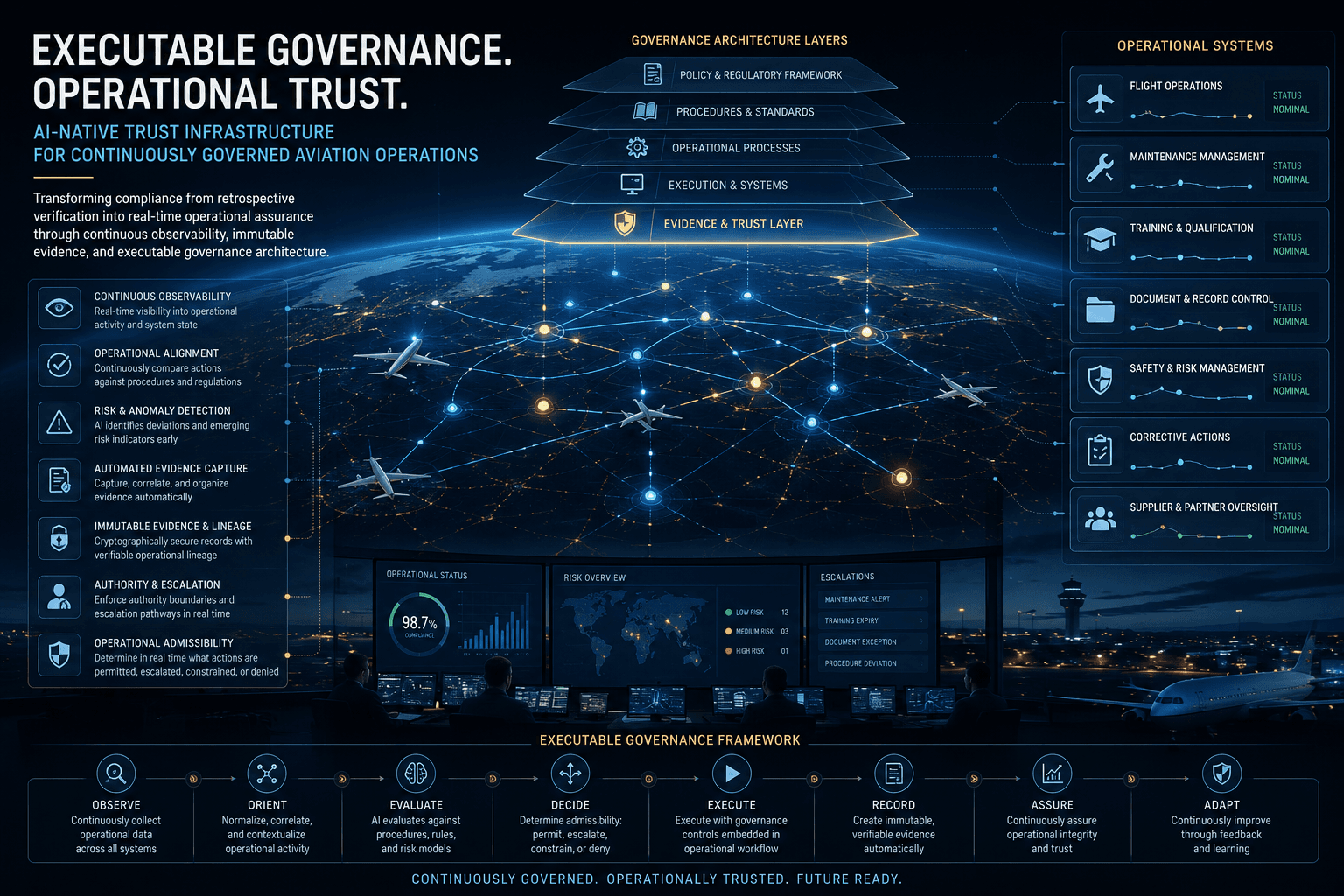
AI systems can now: • continuously monitor operational processes, • compare actions against procedural requirements, • identify anomalies, • retrieve supporting evidence automatically, • map operational behavior against regulatory structures, • surface emerging operational risk indicators, • and support near real-time supervisory visibility.
For the first time, regulated enterprises can achieve continuous operational observability rather than relying solely on periodic snapshots of operational reality.
That distinction matters.
Once operations become continuously observable, governance itself begins moving from retrospective verification toward continuously governed execution.
Continuous Compliance Is Evolving Into Continuous Operational Admissibility
Most organizations still treat governance as an overlay.
• Policies exist separately from systems. • Compliance exists separately from operations. • Audit processes exist separately from execution.
AI-native enterprises cannot scale effectively under that model.
As autonomous and semi-autonomous systems increasingly participate in enterprise operations, governance must become structurally embedded into operational execution pathways themselves.
The critical question is no longer simply:
“Was the organization compliant?”
The emerging question is:
“Was the operational action admissible within the governed operational state?”
This is a materially different governance model.
The future enterprise may continuously evaluate whether operational actions should be: • permitted, • escalated, • constrained, • supervised, • or refused altogether.
That requires: • procedural lineage, • authority architecture, • immutable evidence, • continuous validation, • escalation logic, • supervisory visibility, • and machine-verifiable trust structures.
Governance becomes executable.
The Rise of AI-Native Trust Architecture
AI solves part of the governance challenge by improving operational awareness. But highly regulated industries also require trustworthy operational evidence.
The strongest emerging trust architectures provide: • immutable operational records, • tamper-resistant evidence trails, • trusted revision histories, • continuous integrity validation, • procedural traceability, • and verifiable operational lineage.
Historically, organizations spent enormous administrative effort attempting to prove the accuracy of records after operational activity had already occurred.
But when operational evidence becomes continuously verifiable and procedurally anchored, trust itself becomes embedded into the operational architecture.
This fundamentally alters the structure of compliance, oversight, and institutional accountability.
Aviation May Become the First Executable Governance Industry
Aviation is uniquely positioned to lead this transition because the industry already operates through: • authority boundaries, • procedural discipline, • layered safety systems, • operational escalation, • admissibility logic, • continuously managed risk states, • and consequence-aware decision structures.
For decades, aviation attempted to create safety primarily through increasingly sophisticated oversight systems.
AI-native governance architecture may finally allow aviation to evolve from periodic verification toward continuously governed operational execution.
That shift has implications far beyond compliance efficiency.
It affects: • safety assurance, • operational resilience, • regulatory oversight, • enterprise accountability, • operational intelligence, • and systemic risk reduction.
The future may not belong to systems that merely observe operations.
It may belong to systems capable of continuously validating, constraining, escalating, supervising, and governing operational consequence in real time.
Where BCCS Operates
BCCS should not be understood merely as a traditional compliance platform.
Traditional compliance software manages records.
AI-native governance infrastructure governs operational integrity itself.
BCCS is being designed as a continuously governed trust architecture for regulated operational environments — one capable of integrating: • operational observability, • procedural validation, • evidence integrity, • escalation structures, • authority architecture, • and continuous operational assurance.
Aviation is not simply the market. It is the proving ground for the next generation of executable governance systems.
Summary
• The future of governance will not be built solely through additional policies, larger compliance departments, or more administrative oversight. • Artificial intelligence is reducing the cost of operational awareness. • Emerging trust technologies are reducing the cost of operational verification and evidence integrity. • Governance is evolving from retrospective administration toward continuously governed operational execution. • Continuous compliance is evolving into continuous operational admissibility. • AI-native enterprises will require executable trust architectures embedded directly into operational systems. • Aviation may become one of the first industries to operationalize executable governance at scale.